Corneal Irregularity

What Is Corneal Irregularity?
Corneal irregularity refers to an abnormal shape or surface of the cornea—the clear, dome-shaped front layer of the eye responsible for most of the eye’s focusing power. In a healthy eye, the cornea has a smooth, even curvature that refracts light precisely onto the retina. When irregular, the surface becomes uneven, scarred, thinned, or ectatic (bulging outward), causing light to scatter instead of focus properly. This leads to distorted, blurred, or unstable vision that glasses or standard contact lenses often fail to correct adequately.
Common underlying conditions include:
- Keratoconus: Progressive thinning and cone-like bulging of the cornea.
- Pellucid Marginal Degeneration (PMD): Thinning in a band-like pattern, typically inferiorly, leading to high astigmatism.
- Post-LASIK/PRK Ectasia: A rare complication where the cornea weakens and bulges after refractive surgery.
- Corneal Scarring from infections, injuries, ulcers, or dystrophies.
- Post-Surgical or Traumatic Changes: Including after corneal transplants, radial keratotomy or laser vision correction.
- Corneal Dystrophies: Result in surface irregularities that distort vision and compromise of surface integrity.
At The Scleral Lens Center in Central Ohio, led by internationally recognized expert Dr. Greg DeNaeyer, we specialize in managing corneal irregularity through custom scleral lenses. Dr. DeNaeyer has over 25 years of experience, has lectured globally on specialty lenses, and has published extensively on this topic. His work emphasizes precise fitting for even the most challenging irregular corneas.

Causes of Corneal Irregularity
Corneal irregularity arises from factors that disrupt the cornea’s structural integrity:
- Genetic and Developmental: Keratoconus and PMD often have hereditary components, with progressive changes starting in teens or young adulthood.
- Post-Surgical: LASIK, PRK, or other refractive procedures can weaken the cornea in susceptible individuals, leading to ectasia (thinning and bulging similar to keratoconus).
- Trauma or Injury: Burns, abrasions, or foreign bodies can cause scarring and uneven surfaces.
- Infections and Inflammation: Keratitis, ulcers, or severe dry eye can lead to scarring.
- Degenerative Conditions: Corneal dystrophies or ectatic disorders cause gradual shape changes.
- Other Factors: Eye rubbing (common in allergies), connective tissue disorders, or prior surgeries like radial keratotomy.

Recognizing the Symptoms
Symptoms vary by severity but often include:
- Blurred or Distorted Vision: Wavy lines, double images, or ghosting.
- Irregular Astigmatism: Difficulty correcting with glasses; fluctuating clarity.
- Light Sensitivity (Photophobia): Glare, halos, or starbursts around lights, especially at night.
- Frequent Prescription Changes: Vision worsens over time despite new glasses.
- Eye Strain and Headaches: From squinting or poor focus.
- Reduced Night Vision: Challenges driving after dark.
- Discomfort or Foreign Body Sensation: In cases with associated dry eye or scarring.
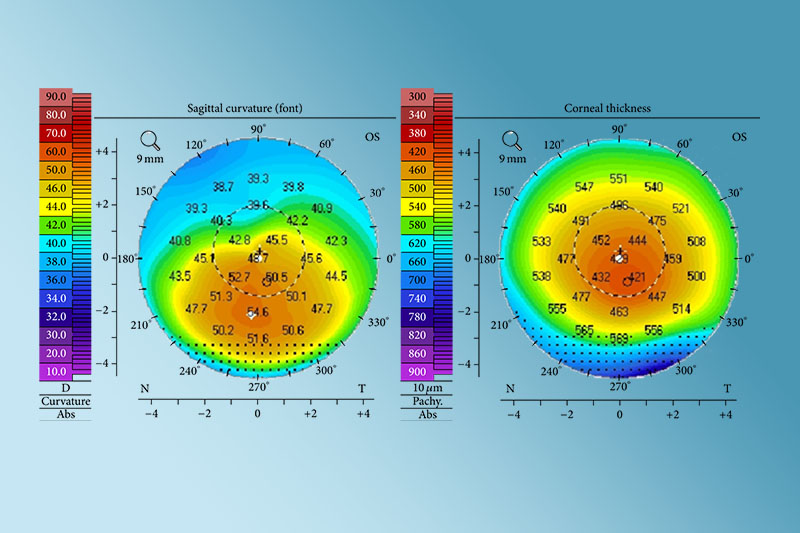
How Is Corneal Irregularity Diagnosed?
Diagnosis involves comprehensive eye exams and specialized testing:
- Corneal Topography/Tomography: Maps the cornea’s shape and thickness (e.g., Pentacam) to detect steepening, thinning, or asymmetry.
- Pachymetry: Measures corneal thickness to identify thinning.
- Slit-Lamp Exam: Checks for scarring, thinning, or ectasia signs.
- Refraction and Visual Acuity Tests: Assesses best-corrected vision and higher-order aberrations.
- Aberrometry: Measures optical irregularities causing distortion.
- Ocular Coherence Tomography (OCT): Provides cross-sectional views of corneal layers.
At The Scleral Lens Center, Dr. DeNaeyer uses advanced corneo-scleral topography and profilometry—topics he has researched and published on—to precisely evaluate irregularity and design optimal scleral lenses.
Treatment Options for Corneal Irregularity
Management depends on severity—ranging from conservative to advanced interventions:
Conservative Approaches
- Glasses or Soft Contacts: Often insufficient for moderate/severe cases due to inability to mask irregularity.
- Rigid Gas Permeable (RGP) Lenses: Better than glasses but may be uncomfortable on irregular surfaces.
- Corneal Cross-Linking (CXL): Strengthens the cornea to halt progression in keratoconus or ectasia (often combined with lenses).
Advanced: Scleral Lenses – The Gold Standard for Vision Correction
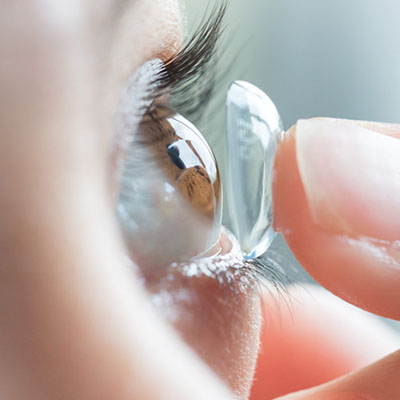
Scleral lenses are large-diameter, rigid gas-permeable lenses that vault over the entire cornea and rest on the sclera (white of the eye). Filled with preservative-free saline, they create a fluid reservoir that:
- Neutralizes irregularities, creating a uniform optical surface.
- Corrects higher-order aberrations for sharper vision.
- Protects the cornea and provides constant hydration.
- Offers superior stability and comfort compared to corneal lenses.
Benefits include:
- Clear, Stable Vision: Many achieve 20/20 or better despite severe irregularity.
- Comfort for Sensitive Eyes: No direct corneal contact reduces irritation.
- Protection: Shields from wind, dust, and dryness.
- All-Day Wear: Ideal for active lifestyles.
Research and clinical experience confirm scleral lenses are iddal for keratoconus, PMD, post-LASIK ectasia, scarring, and other irregularities—often succeeding where other options fail.
Dr. Greg DeNaeyer is a leader in this field with extensive published literature and international lectures. At The Scleral Lens Center, we use custom designs (including multi-meridian and virtually designed lenses) and 3D mapping for precise, life-changing results.
Other Interventions
- Intacs or Rings: For mild keratoconus to flatten the cone.
- Corneal Transplant: Reserved for severe, advanced cases.
- Hybrid or Piggyback Lenses: Alternatives in select cases.
Preventing Progression and Maintaining Eye Health
- Avoid vigorous eye rubbing.
- Manage allergies and dry eye promptly.
- Attend regular exams, especially post-refractive surgery.
- Follow prescribed treatments like CXL if indicated.
Frequently Asked Questions About Corneal Irregularity
Can corneal irregularity be cured?
Most causes are managed rather than cured—scleral lenses provide excellent functional vision.
Are scleral lenses covered by insurance?
Sometimes for medical necessity (e.g., irregularity or ectasia); coverage varies—our team assists with verification.
How long does fitting take?
Initial fitting may require 2–4 visits; custom lenses are fabricated in 1–3 weeks.
Do scleral lenses work for post-LASIK ectasia?
Yes—highly effective for ectasia, restoring vision where glasses/soft lenses fail.
Is it hereditary?
Some forms (keratoconus, PMD) have genetic links; family history increases risk.
Conclusion: Regain Clear Vision with Expert Care

Corneal irregularity doesn’t have to limit your life. With advancements in scleral lens technology, even severe cases patients can achieve sharp, comfortable vision. At The Scleral Lens Center, under Dr. Greg DeNaeyer’s leadership—recognized internationally for his contributions to irregular cornea management—we’re dedicated to personalized solutions that restore clarity and confidence.
If you’re experiencing distorted vision or have been diagnosed with corneal irregularity, schedule a consultation today.